A Frozen Food Courier Guide for Merchants
Getting found, getting chosen, and keeping customers — the visibility and sell engine behind a frozen food brand that ships.
For frozen prepared food, the cold chain and the click chain are the same chain. A product that arrives thawed kills the review that feeds the discovery that drives the next sale. Surviving the journey and selling online are not two jobs — they are one.
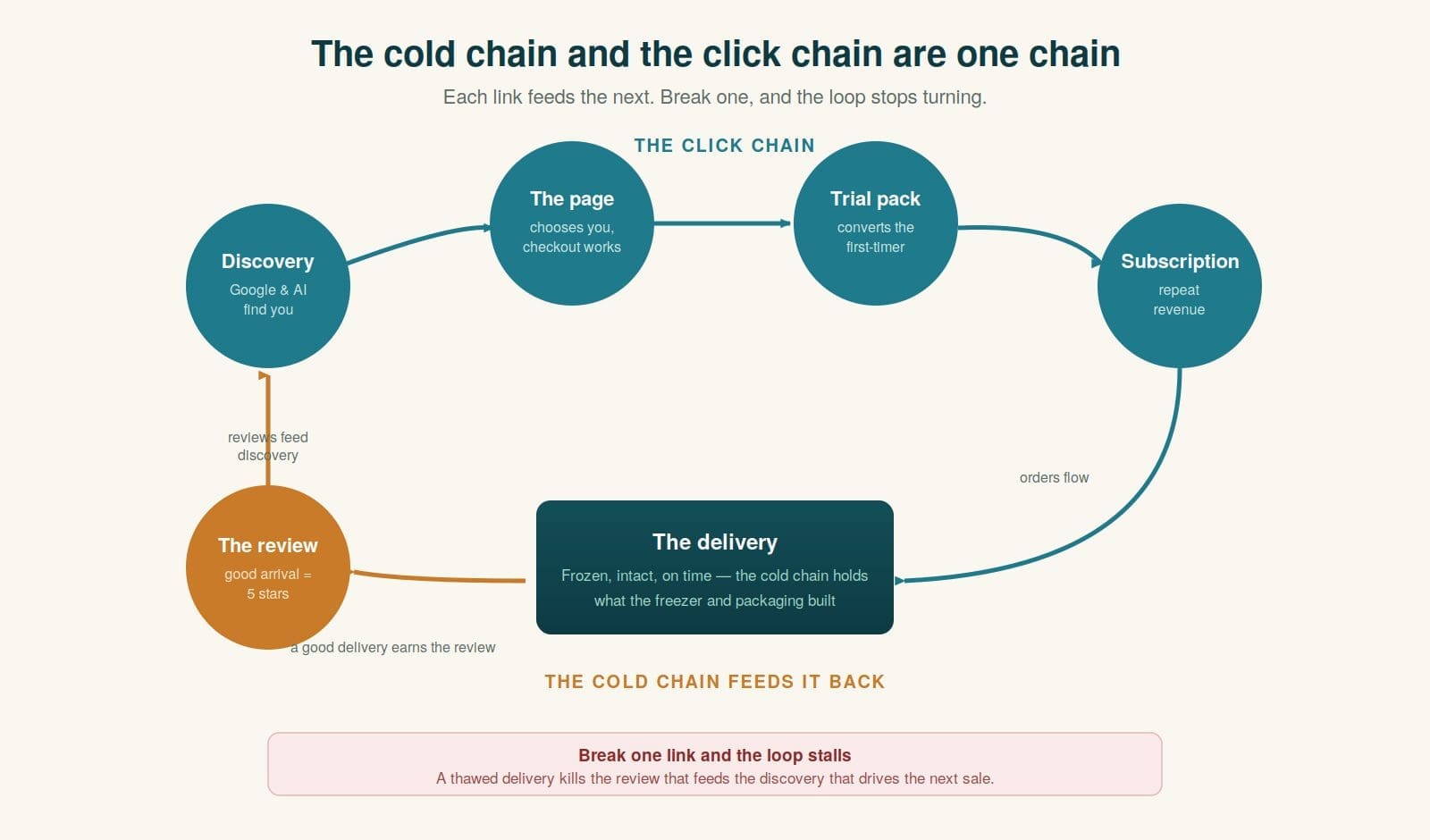
Most frozen food brands we work with have already solved the hard physical problems: they freeze properly, they pack properly, and the goods arrive at temperature. What far fewer have solved is the second half of the chain — being found by the customer in the first place, and turning that first order into a standing one.
This page maps the full journey end to end. Chapters one through six are the focus: the practical, low-cost moves that put your products in front of buyers searching on Google, asking an AI assistant, or scrolling social, the engine that converts a first taste into recurring revenue, and the handful of numbers that tell you what is working. Chapters seven through nine cover the foundation — freezing, delivery, and the e-commerce plumbing — and point you to the in-depth articles we have already published on each.
Visibility, Sell & Measure
The six moves that get you found, chosen and kept
Each chapter wears two hats: marketing (get found & chosen) and sell (convert & keep).
1
Get found
Put your products in Google — for free
A single Merchant Center toggle — Free Listings — puts your products into Google’s Shopping Graph and its AI shopping answers at no cost per click. Most brands run paid ads for years with this switch off, invisible in the organic results that AI actually reads.
2
Get chosen
Convert
Make your product the answer
Feed quality, search-friendly titles, and answering the questions buyers actually ask — so that you become the source an AI quotes by name. For subscription brands, a low-commitment trial pack is the entry product that lists cleanly and converts first-time buyers — and a checkout built for frozen (zone validation, delivery slots) stops the basket being abandoned.
3
Get trusted
Reviews & reputation — where they live matters
Google Business Profile reviews are the only ones that feed Google’s ranking, Maps and AI answers. Facebook bridges to Bing; Hello Peter is a South African reputation layer, not a substitute. And one rule applies everywhere: never buy, incentivise or gate reviews.
4
Keep them
Turn first orders into repeat revenue
The trial pack is the on-ramp; the subscription is the destination. A deliberate hand-off — a well-timed offer to move onto a standing order at a modest saving, with WhatsApp doing the reorder prompts — is the most efficient revenue in the business: predictable, low marketing cost, and exactly suited to frozen meals.
5
Accelerate
Spend
Accelerate with a small, smart ad budget
With the free foundation in place, a modest budget speeds things up rather than propping up a weak base. Spend where the intent already is — Google Performance Max first — then use cheaper social reach to build demand. Paid and free run together, and you measure leads, not clicks.
6
Measure
Know your numbers
A machine you cannot read is a machine you cannot tune. A handful of metrics — the funnel from visit to subscription, CAC against LTV, and the frozen-specific delivery-failure and replacement rates — tell you which step is leaking before ad spend goes to guesswork.
The second front: being found by AI assistants
Google still handles the majority of search — it is not “dead.” But AI-assistant referrals are the fastest-growing new discovery channel, and for a considered purchase like ordering frozen meals, more people now ask an assistant to recommend or compare before they buy. There is a second front opening, and most food merchants are invisible on it.
~25%
of Google searches show an AI Overview (late 2025)
Up to ~35%
more organic clicks for brands cited in an AI Overview
~4×
growth in AI Overview coverage through 2025
The useful part to understand is where these assistants get their data — almost nobody explains this to merchants:
ChatGPT search & Perplexity — lean on live web results, high-authority sources, and community sites like Reddit. Third-party mentions and clear, citable pages are what get you pulled in.
Google AI Overviews, AI Mode & Gemini — read Google’s index plus the Merchant Center Shopping Graph and your Business Profile. This is a direct line back to Chapters 1 and 3.
Across all of them — structured data (schema), genuine reviews, and third-party citations decide whether a brand gets named in the answer.
The practical takeaway is reassuring: getting found by AI is mostly the same hygiene as Chapters 1 to 3 — a clean product feed, schema on your pages, steady Google reviews, and honest third-party mentions — plus a few AI-specific moves. Every checklist in the download below carries an “AI-discovery” line so you never lose sight of it.
Where South African buyers actually are
Choose channels by where your customers spend their attention — not by what is fashionable.
WhatsApp is the country’s most-used platform and the favourite messaging app for roughly one in three internet users, which is why it remains the backbone of direct customer contact and order confirmations. Facebook — at around 28 million users — still carries the broadest reach in the country and doubles as a review source that feeds Bing. TikTok’s reach is real and growing, but it rewards a steady video habit and skews younger than a frozen-delivery buyer, so treat it as a demand-builder you add once you can feed it — not your first channel. YouTube remains the strongest home for demos and “how to cook it” content, and because Google owns it, that content surfaces directly in search and AI answers.
For a frozen-meal brand the sensible starting mix is: WhatsApp for service and reorders, one visual channel (TikTok or Instagram) for demand, and YouTube for the demo content that doubles as an AI-citation asset. You do not need all of them — you need one or two done consistently.
Get the checklists pack
The complete, tick-through checklist for every chapter above — including the AI-discovery line for each step — as an editable document you can work through and hand to your team.
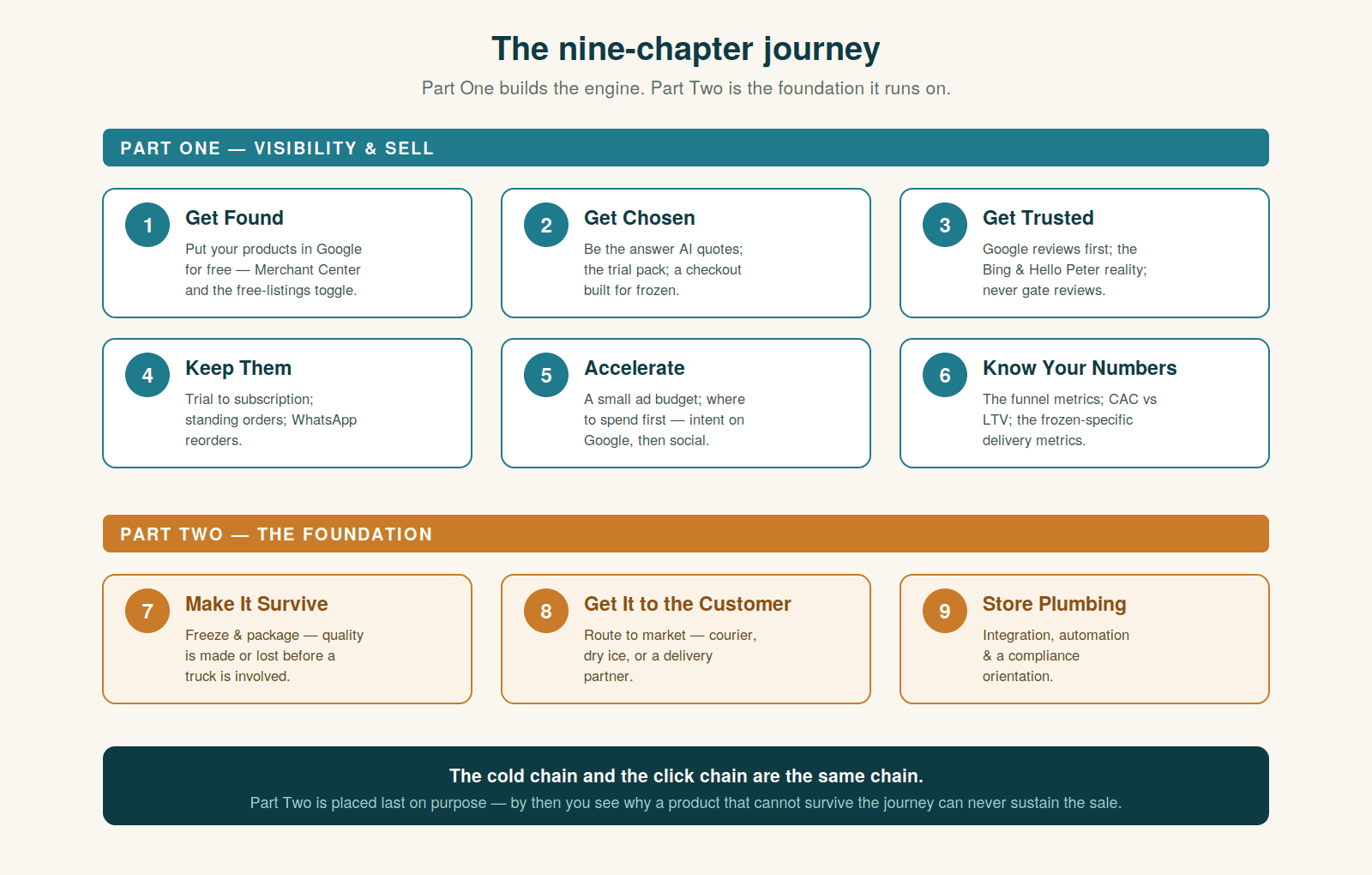
The Foundation
Before you sell it, it has to survive the journey
Chapters seven through nine — the physical chain — draw on articles we have already published. Full chapters are coming; for now, the essential reading.
7
Make it survive — freeze & package
Quality is made or lost in the factory freezer, long before a truck is involved. Freeze it right, pack it right, and the cold chain has something worth protecting.
The Art of Freezing Why “Frozen Solid” Takes Longer Packaging Pre-Made Frozen Meals
8
Get it to the customer — route to market
Choosing how the product travels — refrigerated courier, dry ice, or a delivery partner — sets the ceiling on how far you can sell and how reliably it arrives.
Choosing a Shipping Method The Dry Ice Guide Why Partner for Deliveries?
9
Build the store plumbing — integration & automation
The connection between your store and your courier is what turns an order into a delivery without manual re-keying. Get it automated and the rest scales. Includes a quick compliance orientation for new merchants.
Shipping in E-Commerce Shopify WooCommerce Wix Real-time Tracking R638 & ISO Compliance Maintaining the Cold Chain
A note on tone: some of the articles linked above are written in a deliberately blunt, myth-busting register — they challenge the “industry standard” head-on, because the physics demands it. This guide is calmer by design. When you follow a link into one of those pieces, expect the gloves to come off; the engineering underneath is the same.
All statistics in this guide were verified accurate as at the date of publication (June 2026). Digital platforms, costs and AI-search behaviour change quickly; figures are offered as orientation, not a quote.