
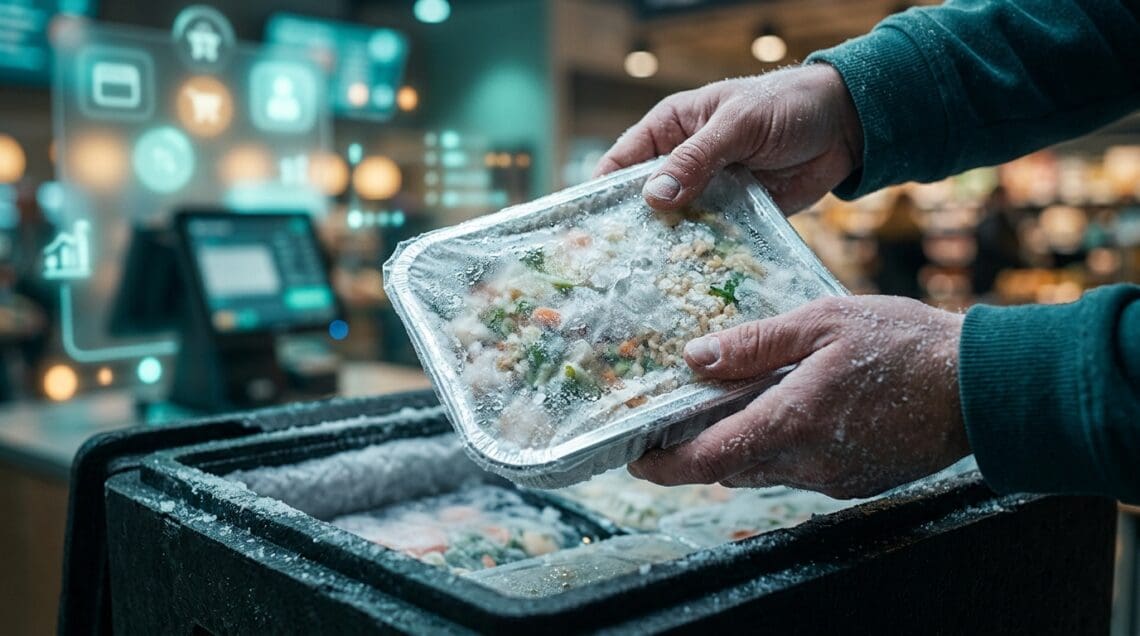
Make Your Frozen Product the Answer
The short version: Getting listed is not the same as getting chosen. To be named inside Google’s AI answers — not merely ranked — your site has to be the easiest, most trustworthy place to extract a clear answer about your food. And once a buyer decides, your checkout has to survive a reality general e-commerce ignores: frozen food cannot go everywhere, and cannot be left at the gate. Get both right and you convert far more of the traffic Chapter 1 sends you.
Why “getting chosen” is a different job for frozen
In Chapter 1 you got your products into Google’s catalogue. That makes you findable. It does not make you chosen. Between a shopper seeing your listing and a paid order landing in your system, two things decide whether you win — and for a frozen-meal brand, both have a frozen-specific twist most guides miss.
The first is being the source an AI quotes by name when a customer asks “what’s the best frozen meal delivery in Joburg” or “are there low-carb frozen dinners that actually taste good.” The second is a checkout that does not collapse the moment frozen reality intrudes — when the customer turns out to be outside your cold route, or cannot be home to receive a product that will not survive eight hours at the gate.
The first job is marketing. The second is the sell. This chapter does both, because for frozen they are the same continuous problem: earning the decision, then not losing it at the last screen.
Two ladders: where they live, and where they’re ready to buy
It helps to picture two ladders rather than one long to-do list. The first is a discovery ladder — the places people already are when they are not yet shopping: Google, social, an AI assistant, a Reddit thread. That is “where they live,” and Chapter 1 climbed it. The second is an intent ladder — the moment a buyer is ready to act and just needs you not to get in the way: the clear answer they were looking for, and a checkout that works. That is “where they’re ready to buy.” This chapter is the hinge between the two — it turns presence where they live into a completed order when they are ready to buy.
AI is not a third ladder; it sits across both. It looks you up on the discovery side, then leans on your clear answer pages and clean reviews to decide whether to name you on the intent side. So everything below does double duty: it converts the human who already found you, and it gives the AI the trustworthy, first-hand source it needs to send you the next one.
Part one — be the answer (Answer Engine Optimisation)
When Google, ChatGPT, Perplexity or Gemini answer a question, they summarise and cite a few trustworthy sources. Getting named is sometimes called Answer Engine Optimisation, and for a manufacturer it is very achievable — because you hold first-hand expertise about your own food that no aggregator or roundup blog can match.
Answer the real questions buyers ask, in the first sentence. Build pages around what customers actually wonder before buying frozen: “how long does it keep,” “how do I reheat it without it going rubbery,” “is it suitable for a toddler,” “how many does one pack feed.” Put the answer in the opening sentence, then expand. AI engines lift clean, direct answers; they skip pages that bury the point under three paragraphs of preamble.
Publish original facts only you have. Portion weights, ingredient lists, freezing method, time-from-freezer-to-plate, nutritional figures. Original numbers are far more likely to be cited, because an AI can verify and lean on them. “Our beef lasagne is 350g, serves one generously, and reheats from frozen in 25 minutes” is quotable. “Our delicious meals are made with love” is not — an AI cannot do anything with it, and neither can a hungry buyer comparing options.
Show who stands behind it. Named authors, a real About page, genuine contact details, your physical reality as a food producer. Trustworthy, clearly-authored content is weighted higher — and for food, where the buyer is trusting you with what their family eats, this is not box-ticking; it is the whole basis of the purchase.
Be the primary source, not a summary of one. Generic “top 10 frozen meal tips” content rarely gets cited. First-hand manufacturer information — this is how we freeze it, this is why it holds its texture — does. This is your structural edge over every reseller and content farm, and it costs you nothing but the discipline to write down what you already know.
The trial pack: the entry product that gets you chosen
For a subscription brand, there is a specific listing strategy that converts far better than putting the subscription itself in front of a first-time visitor. Asking someone who has never tasted your food to commit to a recurring order is a large ask — and recurring-billing products are also awkward to list and get approved in Merchant Center.
Lead instead with a trial pack: a single, well-priced, one-off version of your offering, set up as a standard product.
- It is an easy yes. A small one-off trial removes the commitment barrier. The customer is trying you, not signing up — and that converts far more of the people Google and AI send you.
- It lists cleanly. A straightforward one-off product feeds and gets approved in Merchant Center where a recurring item struggles. Getting it approved also proves your whole feed and account setup works.
- It seeds the signals. Those first trial orders generate the reviews and engagement that lift visibility for everything else you list.
The trial pack is the on-ramp; what you do with the buyer afterward is Chapter 4. Here, it is simply the product most likely to convert a first-time frozen buyer who has just decided you might be the answer.
Part two — build a checkout that survives frozen
This is where most frozen brands quietly lose orders they already won, and where generic CRO advice is worse than useless — because a generic checkout assumes anything can ship anywhere and be left at the door. Frozen breaks both assumptions, at the two exact moments that cost you the sale.
Validate the delivery zone before the basket, not at the end
Frozen food cannot ride a standard economy network to every corner of the country — it needs a cold route. The single most avoidable loss in frozen e-commerce is a customer spending fifteen minutes building a basket of meals, only to hit “we don’t deliver to your area” at the final screen. That is a customer who wanted exactly what you sell, did the work to choose it, and left angry.
Put the zone check up front — a top-bar banner or a homepage field where the customer enters a suburb or postcode before they shop. Someone outside your route finds out in the first ten seconds, not the last. And when they are out of zone, capture their email to notify them if you expand: a bounce becomes a lead.
You already know your coverage is suburb-level, not blanket — some areas are out for distance or risk, and in parts of the Cape a single postcode can mix serviced and unserviced suburbs. A front-end validator simply moves that knowledge to where the customer needs it. It is the cold chain’s real limits, shown honestly at the top of the funnel instead of sprung at the bottom.
Let the customer choose a delivery day
Frozen food cannot be dropped over a gate or left with a guard for eight hours in the South African sun. Someone has to receive it. Real-time tracking (part of the store-plumbing foundation summarised on the guide hub) tells a customer where their order is; choosing a delivery day lets them plan to be there to take it.
Checkout plugins for Shopify, WooCommerce and Wix let buyers pick an explicit delivery day or date — “this Tuesday,” “this Saturday” — rather than a fixed time window. Offering a day rather than an hour keeps your routing efficient while still giving the customer the certainty they need: it removes the anxiety of a missed, thawed delivery, and that anxiety is a genuine reason frozen baskets get abandoned at checkout. A customer who knows which day to expect their order is a customer who completes it.
Prove the cold chain with your own eyes
Buying frozen food online is a leap of faith about temperature and hygiene, and a paragraph describing your packaging will not settle a sceptical first-time browser. Show it. A short unboxing clip — the box arriving, opening, and a crisp, fully-frozen meal lifted out of the insulation — is worth more than any amount of reassuring copy. It is the cleanest possible proof that what your product page promises is what lands at the door.
That same clip earns its keep twice: it converts the hesitant buyer, and (per Chapter 1) video content on a platform like YouTube is itself a discovery and AI-citation asset.
Where this touches the cold chain
The two checkout moves above are not really “conversion optimisation.” They are the cold chain expressing itself in the click chain. Zone validation exists because the cold chain has a finite reach. Choosing a delivery day exists because the cold chain cannot survive an unattended drop. The reason a frozen checkout looks different from a generic one is that the physics of the product reaches all the way up into the buyer’s last click.
Get this right and the order you won by being the answer actually completes — and arrives in a state that earns the review that feeds your next discovery. Get it wrong and you have paid, in attention and effort, to find a customer you then frustrate at the till. (The physical promise behind the delivery day and the route is covered in Maintaining the Cold Chain.)
The AI-discovery angle
AI does not know your brand — it looks you up, and recommends whoever it finds with the clearest, most trusted answer. The two halves of this chapter are how you become that answer, and they feed it in different ways.
Your answer pages — clear, first-hand, frozen-specific — are what ChatGPT and Perplexity quote, because those engines lean on live web content and trustworthy source pages rather than the Shopping Graph alone. A page that answers “how long do frozen meals keep” in its first sentence, with your real numbers, is the kind of source an AI pulls into a comparison.
Your checkout quality feeds it indirectly but powerfully: a checkout that converts and delivers cleanly produces the completed orders, the reviews and the satisfied customers whose words AI engines later summarise when they decide which frozen brand to name. Being chosen by a human and being chosen by an AI turn out to rest on the same foundation — clear answers and a delivery that does what the page promised.
The discipline of earning that mention now has a name — Generative Engine Optimisation (GEO) — and one technical catch worth knowing: an assistant can only quote the answer pages above if its crawler can actually reach your site. Confirm nothing in your robots file, firewall or CDN is turning it away (covered in Chapter 5).
Make your answers machine-readable: schema for being chosen
In Chapter 1 we introduced schema as the label on the back of the tin — the structured data that lets machines read what your page means, not just what it says. For “getting chosen,” the schema that earns its place is FAQ and Product markup, because those are what turn your answer pages into liftable AI answers and your listings into rich results.
A frozen brand’s FAQ markup might wrap the very questions this chapter says to answer:
{
  "@context": "https://schema.org",
  "@type": "FAQPage",
  "mainEntity": [
    {
      "@type": "Question",
      "name": "How many people does one frozen meal pack feed?",
      "acceptedAnswer": {
        "@type": "Answer",
        "text": "Each single-portion pack feeds one adult generously. Family packs feed four. Portion size is listed on every product page so you can order for your household."
      }
    },
    {
      "@type": "Question",
      "name": "Will the meals arrive frozen?",
      "acceptedAnswer": {
        "@type": "Answer",
        "text": "Yes. Every order travels in a temperature-controlled vehicle and is handed to you frozen. You choose a delivery day at checkout so you can receive it directly."
      }
    },
    {
      "@type": "Question",
      "name": "What if I am outside your delivery area?",
      "acceptedAnswer": {
        "@type": "Answer",
        "text": "Enter your suburb before you shop to confirm we deliver to you. If we don't reach you yet, leave your email and we'll let you know when we expand."
      }
    }
  ]
}
Read those answers again: each one reassures the human and hands an AI a clean, frozen-specific fact to quote — and each maps to a real conversion concern (portion, temperature, coverage). That is schema doing both jobs at once.
On SmartCrawl
We run SmartCrawl Pro on this site, and its Schema Types Builder supports FAQ and Product markup, assignable to specific pages and product types. As we noted in Chapter 1, the plugin supplies the structure but not the substance: it will not know your portion sizes, your delivery areas or that a product is frozen unless that data comes from your store or you configure it. Set up FAQ schema on your answer pages, Product schema on your listings (in Schema → Types Builder), make sure the data says frozen and in stock, and then — the step most merchants skip — verify it actually emits using Google’s Rich Results Test. If the test cannot read it, neither can the AI.
Your Get-Chosen checklist
- Build answer pages around the real questions frozen buyers ask, with the answer in the first sentence.
- Publish original, first-hand facts: portions, reheating times, ingredients, freezing method.
- Show named authors, a real About page, and genuine contact details.
- Set up a trial pack as a clean one-off entry product.
- Add a front-end delivery-zone validator before the basket — and capture out-of-zone emails.
- Add delivery-day selection at checkout.
- Put an unboxing video on your product or “how it works” page.
- Add FAQ and Product schema to the relevant pages, and verify with the Rich Results Test.
- AI-discovery line: AI does not know your brand — it looks you up; clear, first-hand answer pages are what it quotes, so be the primary source, not a summary of one.
This is Chapter 2 of the full guide. Previous: Get Found. Next: Get Trusted — reviews, reputation, and where they actually count. Want the whole thing in one place, plus the consolidated checklists? Get the complete guide.
A note on tone: some of the articles we link to are written in a deliberately blunt, myth-busting register — they challenge the “industry standard” head-on, because the physics demands it. This guide is calmer by design. The engineering underneath is the same.


