
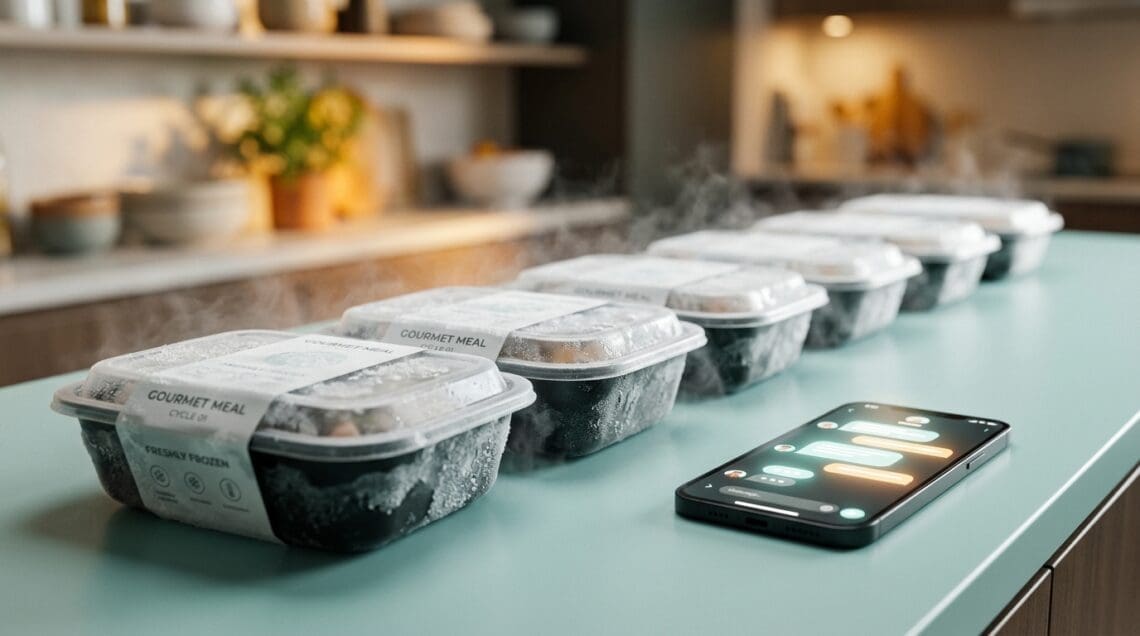
Turning a First Frozen Order into Repeat Revenue
The short version: The trial pack is the on-ramp; the subscription is the destination. Once a customer has tasted your food and seen it arrive properly frozen, that is the moment to move them onto a standing order — the same meals on a regular cycle, usually at a small saving. This is the most efficient revenue in the business: predictable, low marketing cost per sale, and almost perfectly suited to how people actually eat. For a frozen brand, the retention engine is not a bonus on top of the sale; it is the whole point of the sale.
Why retention is where frozen actually makes money

Everything in the first three chapters costs something to win a customer — attention, content, ad spend, the work of being found and chosen and trusted. If that customer buys once and disappears, the economics barely work. If they buy every week for two years, the same acquisition cost is spread across a hundred orders, and the business becomes genuinely profitable.
Frozen prepared food is unusually well-suited to this, for a simple reason: people eat on a cycle. Dinner happens every night whether they planned for it or not. A customer who has solved “what’s for dinner” with your meals has a recurring problem you recurringly solve — which is the textbook definition of a subscription that sticks. You are not persuading someone to want a thing repeatedly; you are removing a chore they face repeatedly.
So the question this chapter answers is not “how do I get a repeat sale” in the abstract. It is: how do I convert the trial buyer from Chapter 2 into a standing order, and keep them there.
The hand-off: from trial pack to subscription
The trial pack exists to start the relationship. The subscription is where the value is. The single most important moment in the whole funnel is the hand-off between the two — and most brands either fumble it or skip it entirely, leaving their best revenue on the table.
Build the hand-off deliberately. Follow up every trial purchase with a clear, well-timed offer to subscribe. Not a vague “thanks for your order” — a specific invitation: the meals you just tried, delivered every week (or fortnight), at a small saving, cancel anytime. This step is the heart of the model, and it should be a designed sequence, not an afterthought someone remembers to send.
Time it to the taste, not the transaction. The right moment is after they have eaten the food and it landed well — not the instant the payment clears. For frozen, that means a few days after delivery, once they have actually reheated a meal and formed an opinion. A follow-up that arrives before they have tasted anything is asking them to commit on faith they have not yet been given a reason to have.
Price the subscription to reward commitment. A modest saving versus repeated one-off buying is usually enough to lock in the habit — you are not discounting your way to a sale, you are rewarding the customer for removing the friction of re-ordering. The maths works in your favour: a subscriber costs you almost nothing to re-sell to, so a small per-order saving is cheap insurance on a long relationship.
Make the subscription effortless to stay in
A subscription does not fail because the food got worse. It fails on friction — a customer who wanted to skip a week, couldn’t find how, and cancelled the whole thing rather than fight the interface. For frozen especially, where a customer’s freezer fills up some weeks and empties others, flexibility is retention.
- Let them skip, pause and change cadence easily. A customer going on holiday should be able to pause in two taps, not cancel. A freezer that is still full should trigger an easy “skip this week,” not a billing dispute. Every friction point you remove is a cancellation you prevent.
- Let them swap meals. The fastest route to boredom-driven churn is the same five dishes forever. Rotating the available menu, and letting subscribers adjust what is in their box, keeps the standing order feeling fresh rather than stale.
- Make changes self-service. A customer who has to phone or email to change their order will, eventually, find it easier to just stop. The easier it is to adjust, the less often they need to quit.
WhatsApp: the South African retention channel
This is where a South African frozen brand has an advantage most overseas playbooks never mention. WhatsApp is the country’s most-used platform and the favourite messaging app for roughly one in three internet users — and it is the channel your customers actually open, unlike the marketing email that lands unread.
For retention specifically, WhatsApp does three jobs better than anything else:
- Reorder prompts that get seen. “Your usual order goes out Thursday — want to add anything or skip this week?” sent on WhatsApp gets read and answered in a way an email never will. It turns the standing order into a light, friendly check-in rather than a silent charge.
- Delivery confirmations and the slot reminder. The reminder that protects a frozen delivery — someone needs to be home to receive it — belongs on the channel the customer checks. A WhatsApp “out for delivery, arriving in your 9am–1pm slot” is the difference between a received order and a thawed one left at the gate.
- Frictionless changes. A customer replying “skip next week” to a WhatsApp prompt is a customer who stayed subscribed instead of cancelling because the website felt like effort.
A crucial point from the channels section of this guide: if a customer reorders via a WhatsApp chat, connect that back to your store so it is recorded — otherwise the repeat revenue that proves your retention is working stays invisible to your analytics, your reviews flow, and the numbers you will track in Chapter 6. Use WhatsApp as the conversation layer on top of the store, not as a separate, untracked order book.
Where this touches the cold chain
Retention is where the cold chain pays you back, compounding.
Every standing-order delivery is a fresh chance to either reinforce the habit or break it. A subscriber whose meals arrive frozen, on time, in their chosen slot, week after week, becomes the most valuable customer you have — and, quietly, your best marketer, because that reliability is what they mention when they review you and what they tell the friend who asks. A single thawed delivery to a long-standing subscriber does disproportionate damage: it does not just cost one order, it shakes the trust that underwrites every future one and can end a relationship worth a hundred deliveries.
This is the compounding logic of the whole guide, seen from the retention end. The cold chain protects the delivery; the reliable delivery protects the subscription; the subscription is the revenue. A brand that controls its last mile is not just delivering food — it is protecting the recurring relationship that makes the entire acquisition effort of Chapters 1 to 3 worth it. (The discipline behind a delivery that keeps a subscriber is covered in Maintaining the Cold Chain.)
The AI-discovery angle
Retention feeds discovery in a way that is easy to miss, because the effect is indirect — but it is real and it compounds.
Long-standing, happy subscribers do two things that strengthen your visibility for free. They leave more reviews, and better ones — a customer who has reordered for six months writes with more conviction and more specifics than a one-time buyer, and (per Chapter 3) it is exactly that descriptive review text that AI engines summarise when recommending a frozen brand. And they generate branded search — a satisfied subscriber who tells a friend sends that friend Googling your name, which is the strongest organic signal there is.
So the retention engine is not sealed off from the discovery engine. A brand that keeps its customers is, without spending another rand on marketing, continuously refreshing the reviews and the branded interest that feed Google and AI. Keeping customers is, among other things, a discovery strategy.
Make the offer machine-readable: subscription and offer schema
As covered in Chapter 1, schema is the structured “label on the back of the tin” that lets machines read what your page means. For the retention offer, the relevant markup is Offer and Product data that expresses the subscription clearly — so that when an AI is asked “is there a frozen meal subscription in Cape Town,” your recurring offer is legible to it, not buried in prose.
A worked example, marking up a subscription offer on a product page:
{
  "@context": "https://schema.org",
  "@type": "Product",
  "name": "Weekly Frozen Dinner Plan — 5 Meals",
  "brand": { "@type": "Brand", "name": "Full Circle Food" },
  "description": "Five frozen single-portion dinners delivered weekly, in a temperature-controlled vehicle on your chosen slot. Skip, pause or change anytime.",
  "offers": {
    "@type": "Offer",
    "priceCurrency": "ZAR",
    "price": "549.00",
    "availability": "https://schema.org/InStock",
    "url": "https://thefrozenfoodcourier.co.za/",
    "eligibleCustomerType": "Returning and new customers"
  }
}
The point is the same as in every chapter: the structured data lets a machine understand that you offer a recurring frozen-meal plan, in rand, available now — which is precisely what an AI needs to surface you for a subscription query. The recurring-billing mechanics themselves live in your store platform; the schema simply makes the offer legible.
On SmartCrawl
We run SmartCrawl Pro, whose Schema Types Builder handles Product and Offer markup. As in the earlier chapters, the plugin supplies the structure but not the substance — it will not know your plan price, cadence or availability unless that comes from your store data or you configure it. A practical note specific to subscriptions: recurring-billing products can be awkward to represent cleanly, which is part of why Chapter 2 recommends leading your listings and feed with the one-off trial pack while using schema like the above to make the subscription legible on its own page. Configure it under Schema → Types Builder, point it at real store data, and verify with Google’s Rich Results Test.
Your Keep-Them checklist
- Build a deliberate hand-off sequence from trial pack to subscription — not an afterthought.
- Time the subscription offer to the taste — a few days after delivery, once they’ve eaten.
- Price the subscription to reward commitment with a modest, sustainable saving.
- Make the subscription effortless to stay in: easy skip, pause, cadence change and meal swaps.
- Use WhatsApp for reorder prompts, the delivery-slot reminder, and frictionless changes.
- Connect WhatsApp reorders back to your store so the repeat revenue is recorded.
- Mark up the subscription with Offer / Product schema and verify with the Rich Results Test.
- AI-discovery line: loyal subscribers leave more, better reviews and generate branded search — retention quietly refreshes the very signals that feed Google and AI discovery.
This is Chapter 4 of the full guide. Previous: Get Trusted. Next: Accelerate — a small, smart ad budget and where to spend it first. Want the whole thing in one place, plus the consolidated checklists? Get the complete guide.
A note on tone: some of the articles we link to are written in a deliberately blunt, myth-busting register — they challenge the “industry standard” head-on, because the physics demands it. This guide is calmer by design. The engineering underneath is the same.


