This is Chapter VII of The Art of Freezing — a seven-part series on the physics that determines whether frozen food survives the journey. Read the series overview here.
The Last Chapter Begins With a Walk Down the Frozen Aisle
Pick up any frozen product in a South African supermarket. Read the front of the pack. You will find one of the following claims, or something very close to it:
- Flash frozen
- Snap frozen
- Quick frozen
- Fresh frozen
- Blast frozen
- Individually quick frozen (IQF)
Now ask a simple question: what is the legal definition of any of these terms in South Africa?
The answer is silence. South Africa has no regulated definition for “flash frozen,” “snap frozen,” “quick frozen,” “fresh frozen,” or any variation thereof. No producer is required to demonstrate that their product was frozen using any particular method, at any particular speed, or in any particular equipment. Any producer can print any of these terms on any product frozen in any freezer — including a domestic chest freezer from a hardware store.
“The most sophisticated deception does not require lying. It requires using technically defensible language that implies something which cannot be proved.”
Six chapters of this series have built the evidence base. Chapter I established what ice crystals actually do to food at the cellular level. Chapter II explained how water, protein, fat, starch, and solutes each respond to sub-zero temperatures. Chapter III showed how composite meals fail at their weakest component. Chapter IV proved why speed through the critical zone — -1°C to -5°C — is the single most important variable. Chapter V demonstrated how geometry and packaging determine whether that speed is even achievable. Chapter VI revealed how transit and recrystallisation attack what initial freezing built.
This chapter — the capstone — examines what happens when none of that physics is required by law, and how you, as a producer, a buyer, or a customer, can tell the difference between engineering and marketing.
Section 1: The Regulatory Landscape — What South Africa Actually Requires
South Africa’s primary regulatory instrument governing frozen food is R638 — Regulations Governing General Hygiene Requirements for Food Premises, the Transport of Food and Related Matters, published under the Foodstuffs, Cosmetics and Disinfectants Act 54 of 1972. R638 establishes requirements for storage and transport temperatures, hygiene standards for food premises, and cold chain maintenance obligations.
What R638 does not do is define how frozen food must be frozen. It specifies that frozen food must be kept frozen — typically at -18°C or below — but it is silent on the freezing process itself. There is no provision requiring blast freezing, no minimum freezing speed, no maximum time-in-critical-zone requirement, and no obligation to disclose freezing method on labelling.
The South African Bureau of Standards (SABS) maintains various SANS standards relevant to food safety and quality, but none establish a regulated definition for “flash frozen” or equivalent terms that would bind producers to specific technical performance criteria.
South African food labelling is governed primarily by the Foodstuffs, Cosmetics and Disinfectants Act and regulations thereunder, which require accurate and non-deceptive labelling. This creates a theoretical argument that claiming “flash frozen” on a product frozen in a domestic freezer could constitute misleading labelling — but only if “flash frozen” has a recognised technical meaning that consumers are assumed to understand. In the absence of a regulated definition, that argument is difficult to prosecute.
The result: producers self-certify their claims, and there is no mechanism to verify them.
Note on temperature standards: R638 sets -18°C as the statutory minimum for frozen food storage and transit. The IIR-backed Move to Minus 15°C campaign — validated by 18 months of Campden BRI commercial trials — proposes -15°C as a scientifically sufficient transit target. R638 does not change until regulation is amended, but the physics argument is already settled. See: The 100-Year Mistake: Why -18°C Was Never Based on Science

Section 2: What “Quick Frozen” Means Where It Is Actually Defined
Not every jurisdiction has left this question open. The European Union has had a legal definition of “quick frozen” since 1989.
EU Council Directive 89/108/EEC defines quick-frozen foodstuffs as those subjected to a quick-freezing process in which the zone of maximum ice crystallisation is crossed as rapidly as possible, and the resulting product temperature is then stabilised at -18°C or below. The Directive requires that quick freezing be carried out promptly after preparation, using appropriate technical equipment, on raw materials of sound quality. Critically, it specifies that only air, nitrogen, and carbon dioxide meeting defined purity criteria may be used as cryogenic media — meaning the freezing method is itself regulated, not merely the outcome temperature.
The Codex Alimentarius Commission — the joint FAO/WHO body that sets international food standards — similarly defines quick freezing as a process in which a product passes through the maximum ice crystal formation zone of -1°C to -5°C in 30 minutes or less, achieving thermal equilibration at -18°C or below throughout.
The International Institute of Refrigeration (IIR) provides the engineering definition: freezing rate is measured as the ratio of minimum distance from the product surface to its thermal centre, divided by the time required for that centre to transit from its initial freezing point to a temperature 10°C below that point. A “quick frozen” product achieves this at rates consistent with blast freezing equipment — typically 0.5 to 3 cm per hour for most food products, compared to 0.1 to 0.5 cm per hour in a domestic or commercial walk-in freezer.
These definitions share a common engineering requirement: the maximum ice crystal formation zone must be traversed as rapidly as technically possible. Not as rapidly as a domestic chest freezer permits. As rapidly as equipment designed for the purpose permits — which means, in practice, blast freezing.
South Africa has imported the -18°C storage requirement from international standards. It has not imported the process definition that gives “quick frozen” its meaning.

Section 3: How to Detect the Truth Without a Laboratory
You do not need a cryo-scanning electron microscope to detect poor freezing. The evidence is written into the product itself, and it can be read with kitchen equipment and basic observation. Six chapters of this series have given you the theoretical framework. Here is how to apply it as a practical quality assessment.
Test 1: The Drip Loss Test
This is the most reliable single indicator of freezing quality, and it requires only a scale and a rack.
- Weigh the frozen product before thawing. Record as W₁.
- Thaw the product on an elevated rack over a tray — do not allow it to sit in pooled liquid.
- Thaw at refrigerator temperature (4–6°C) for 12–24 hours to minimise handling damage.
- Weigh the drip collected in the tray. Record as W_drip.
- Calculate: Drip Loss % = (W_drip / W₁) × 100
Interpreting the result:
| Drip Loss % | What It Means | Likely Freezing Method |
|---|---|---|
| 0.5 – 2% | Excellent — minimal cell membrane damage | Blast freezer or IQF tunnel |
| 2 – 4% | Acceptable — some crystal damage, borderline commercial | Commercial plate freezer or slow blast |
| 4 – 7% | Poor — significant ice crystal damage, structural compromise | Walk-in freezer, slow commercial unit |
| 7 – 12% | Severe — extensive cell rupture, product quality fundamentally compromised | Domestic chest/upright freezer |
| >12% | Critical — product has been either very slowly frozen or has experienced freeze-thaw cycling | Inadequate equipment or temperature abuse |
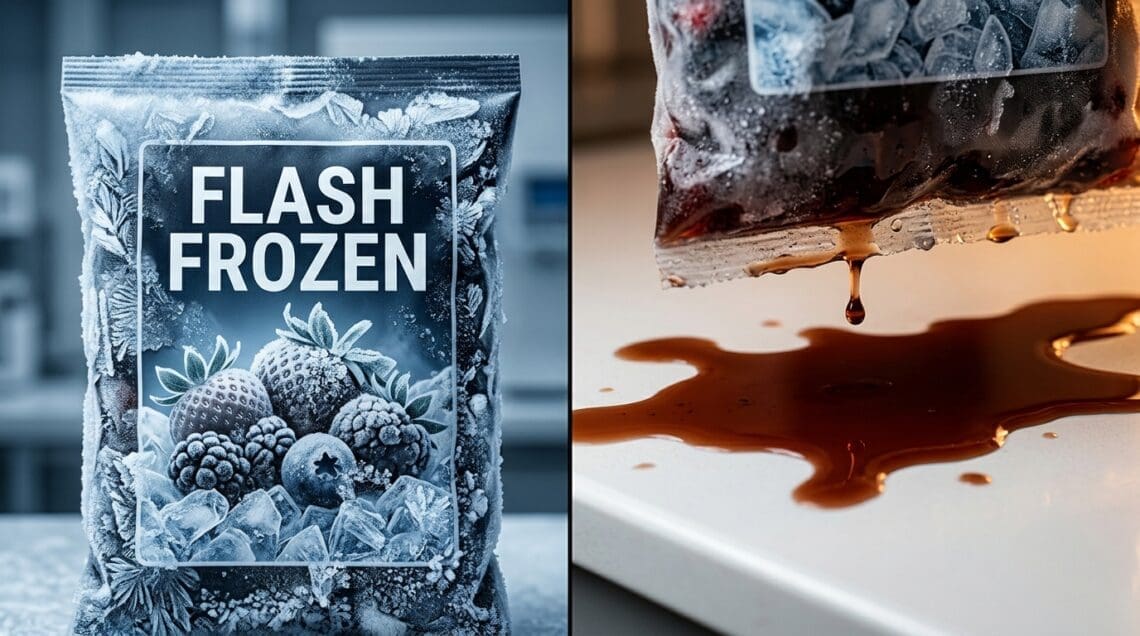
The reddish colour of the drip from meat and poultry is myoglobin — the oxygen-carrying protein inside muscle cells. Its presence in the drip is direct evidence of cell membrane rupture. When a producer claims their chicken breast is “flash frozen” and your drip loss test returns 8%, the physics has provided its verdict regardless of what the label says.
Test 2: Texture After Thawing
Properly blast-frozen protein — chicken breast, beef mince, fish fillets — maintains firm, distinct muscle fibre structure after thawing. Slowly frozen equivalents exhibit what food scientists call “mushy texture”: fibres that have lost their structural integrity because the cell membranes containing them were ruptured by large ice crystals.
For composite meals, the failure is often component-specific. A “flash frozen” ready meal from a domestic freezer will frequently show mushiness in chicken or fish components while vegetables and starches appear intact — because different food matrix components (Chapter III) have different vulnerabilities to slow-freezing ice crystal damage.
Test 3: Internal Frost Pattern
Open a frozen product before fully thawing it. Blast-frozen products show fine, uniform, almost invisible frost distributed evenly throughout the interior. Slowly frozen products show visible white ice masses — sometimes large crystalline formations — particularly concentrated in the spaces between food components and at the product centre, where the freezing front arrived last and moved most slowly.
This is the visual expression of Chapter I’s physics: slow freezing produces large extracellular crystals that grow in the spaces between cells and components, visible to the naked eye. Fast freezing produces small intracellular crystals that are individually invisible.
Test 4: Packaging Frost and External Ice
Excessive frost on the exterior of packaging — the white crystalline coating often visible inside freezer bags or on vacuum-sealed pouches — indicates moisture migration during freezing. This occurs when food is sealed while still warm (releasing moisture into the package headspace) or when the product has experienced temperature cycling that causes sublimation and redeposition.
Neither condition is consistent with professional blast freezing, which requires food to be cooled to near-refrigeration temperature before sealing and freezing. External packaging frost is not proof of poor freezing, but its presence alongside other quality indicators is a reliable signal that process controls were inadequate.
Test 5: Core Hardness and Uniformity
Press a frozen product at its geometric centre. Properly frozen product — where the thermal core has reached -18°C and equilibrated — will feel uniformly hard throughout. A product that was only surface-frozen when dispatched, or that experienced thermal stratification during storage, will show a discernible difference between surface hardness and core resistance. The surface may feel rock-solid while the centre yields slightly under pressure.
This is the condition described in our article Why “Frozen Solid” Takes Longer Than You Think: a product that has completed Phase 3 (surface freezing) but not Phase 5 (solid cooling to uniform -18°C) feels frozen but is not safely or properly frozen for transport.

Section 4: What Honest Producers Can Do — Transparency as Competitive Advantage
The absence of regulatory requirements does not prevent voluntary transparency. In fact, in a market where every competitor can claim “flash frozen” without verification, demonstrated transparency becomes a competitive differentiator. Here is what honest producers can do that their competitors cannot credibly replicate.
State the Actual Method and Equipment
Instead of “flash frozen,” specify: “Blast frozen in a [brand/model] blast freezer at -35°C with 3 m/s air velocity. Critical zone transit time: under 20 minutes.” This is technically verifiable and essentially impossible for a competitor using a chest freezer to replicate truthfully. If a competitor matches your claim without matching your equipment, they are exposed.
Publish Freezing Time Data
Temperature loggers placed inside product during blast freezing generate a time-temperature curve. This curve shows exactly when the product entered the critical zone and when it exited. For a 200g chicken breast in a well-specified blast freezer: critical zone entry at approximately -1°C, exit at -5°C, elapsed time: 8–12 minutes. This data can be summarised on packaging or made available via QR code. It transforms a claim into evidence.
Provide Temperature Monitoring Certificates with Deliveries
Temperature certificates from calibrated monitoring systems — such as Cold Watch SANAS-traceable sensors — document that product temperature was maintained from loading to delivery. Combined with the producer’s freezing documentation, this creates an unbroken evidence chain: frozen correctly, transported correctly, delivered correctly.
This is what The Frozen Food Courier provides on every consignment: verifiable SANAS-traceable temperature data from collection to delivery. The combination of a producer’s blast-freezing certificate and our transport monitoring certificate gives end customers something that “flash frozen” on a label can never provide — proof.
Before-and-After Thaw Photography as Marketing
The drip loss test is not just a quality verification tool. It is marketing content. A properly blast-frozen chicken breast that produces 1.2% drip loss, presented alongside the same product from a competitor’s “flash frozen” product producing 7.8% drip loss, tells a story that no amount of label copy can match. Physics on a plate.
Producers who invest in proper blast-freezing equipment and who can demonstrate the difference visually are not merely complying with best practice — they are creating content that converts customers who understand what they are looking at, and educates customers who don’t yet know to ask.
Section 5: The Regulatory Gap — What Should Change and Why It Hasn’t
We are not lobbyists. We are couriers with physics degrees and operational data. But the regulatory gap described in this chapter has real consequences for South African consumers and for the producers who invest in proper equipment.
What Currently Exists
R638 establishes temperature maintenance obligations for frozen food in storage and transport. The Foodstuffs Act’s general prohibition on misleading labelling provides a theoretical backstop. These frameworks protect consumers against obviously false claims but provide no mechanism to enforce the technical standards implied by terms like “flash frozen” because those standards are not codified.
What is Missing
A regulated definition of “quick frozen” or equivalent terms, aligned with Codex Alimentarius and EU Directive 89/108/EEC standards, would require that products using these claims:
- Pass through the -1°C to -5°C critical zone within a defined time limit (30 minutes or less, consistent with Codex).
- Be produced using equipment capable of achieving this rate — effectively requiring blast freezing for commercial scale.
- Carry labelling that discloses the freezing method or provides verifiable technical parameters.
Such regulation would not prohibit slow freezing — it would simply prohibit calling it “flash frozen.”
Why It Hasn’t Changed
The frozen food industry in South Africa is dominated by large producers whose brands rest partly on freezing quality claims. These producers have not publicly advocated for regulated definitions because the current environment allows them to maintain quality-adjacent marketing language without the compliance cost of proving it. Smaller producers — many of whom genuinely cannot afford blast-freezing equipment — would face competitive disadvantage if required to either invest in proper equipment or remove quality claims from their packaging.
The regulatory incentive structure therefore produces inertia: big producers prefer a low-proof environment, small producers prefer to continue claiming equivalence with large producers, and regulators have not received sufficient pressure from consumers or industry bodies to prioritise the gap.
The physics does not care. Ice crystals form according to thermodynamic laws regardless of what the label says.
Conclusion: The Verdict the Physics Already Delivered
Every chapter of this series has built toward a single conclusion: the quality of a frozen product is determined by physics, not by labelling. The -1°C to -5°C critical zone does not read packaging claims. Recrystallisation during transit does not respect marketing budgets. The drip loss test does not care what the brand name is.
Producers who invest in blast-freezing equipment, who control critical zone transit time, who account for product geometry and composite meal matrix differences, and who partner with couriers who maintain verifiable -15°C throughout delivery — these producers are building a defensible quality position. Not because regulators require it. Because physics requires it, and because customers who understand the difference will reward it.
Producers who use the language of quality without the investment it implies are gambling with their customers’ trust and their own brand equity. Every photograph of a mushy thawed product posted on social media is a physics verdict rendered in public.
“Every frozen product carries the memory of how it was frozen. Physics does not forget. Neither does your customer.”
This series ends here. The physics does not.
The Art of Freezing — Complete Series
- Overview: The Art of Freezing — A Cold Chain Treatise
- Chapter I — Know Your Enemy: Ice Crystal Physics
- Chapter II — The Five Elements
- Chapter III — The Food Matrix
- Chapter IV — Speed and Timing
- Chapter V — The Shape of Battle
- Chapter VI — Transit and Recrystallisation
- Chapter VII — Deception: Labels vs Physics (this article)
Related Reading
- The 100-Year Mistake: Why -18°C Was Never Based on Science
- Why “Frozen Solid” Takes Longer Than You Think
- Technical Formulas Reference
- Cold Chain Glossary
The Frozen Food Courier operates temperature-controlled courier services across Gauteng and Western Cape, maintaining R638 compliance with SANAS-traceable monitoring on every consignment. We have covered many thousands of kilometres in frozen food delivery. The physics in this series is validated by every one of those kilometres.